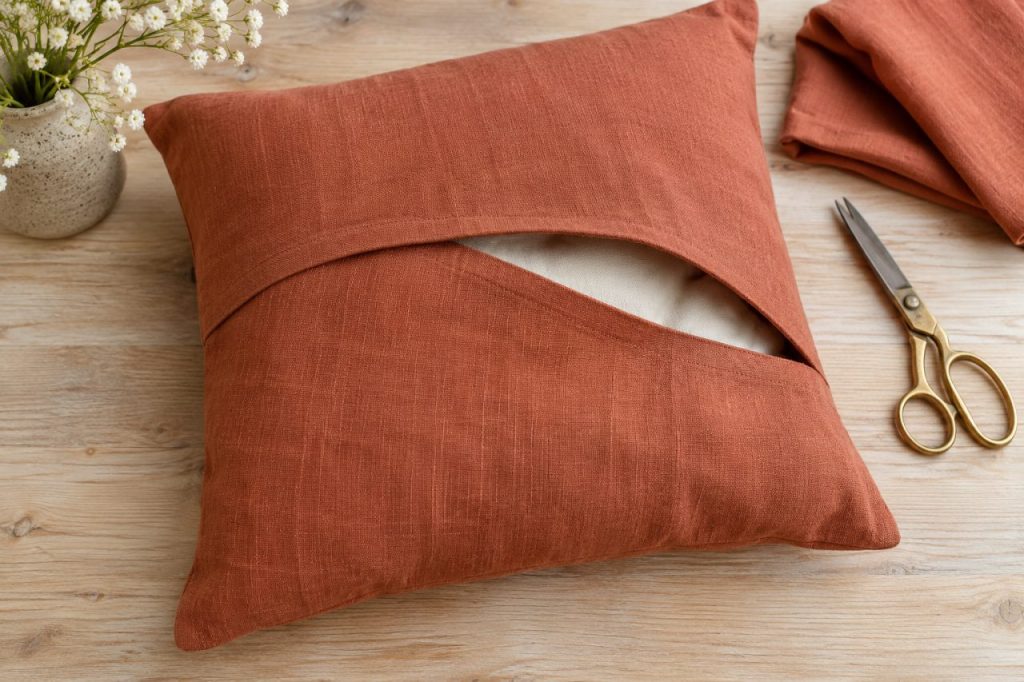
An envelope cushion cover has overlapping back panels instead of a zip. It is a useful first home-sewing project because the seams are straight and the cover can be removed for washing. Start with an ordinary square cushion and a stable woven fabric. Stretchy, slippery or very thick materials make the first attempt harder than it needs to be.
Prepare the fabric and measurements
Measure the cushion across both directions without compressing it. Follow the fabric’s care information when prewashing and drying, then press it safely. Check whether the print has a top and bottom. The worked example below makes an approximately 40 cm square cover with 1 cm seam allowances. For a different cushion, recalculate the pieces rather than simply scaling a photograph.
Cut the three pieces
For this example, cut one front panel 42 by 42 cm and two back panels 42 by 30 cm. On one 42 cm edge of each back panel, turn 1 cm to the wrong side, then another 1 cm, press and stitch the hem. Each back panel is now approximately 42 by 28 cm. Keep both finished edges straight; these are the visible edges of the opening.
Arrange the envelope
Lay the front panel right side up. Put the two back panels on it right sides down, with their raw outer edges aligned to opposite edges of the front. The hemmed edges overlap in the middle by about 14 cm. Check the print direction before pinning or clipping. The outer shape should still be a 42 cm square, with no part of the front stretched to fit.
Sew and finish
Sew around the outside with a 1 cm allowance, securing the beginning and end. Remove pins before the needle reaches them and follow your machine’s instructions. Finish the raw edges with an appropriate zigzag or overlocking method. Trim excess corner bulk carefully without cutting the stitching, then turn through the envelope opening. Ease out corners with a blunt tool and press according to the fabric’s care requirements.
Check the fit
Insert the cushion and smooth the cover. If the opening gapes, check that the panels were cut and hemmed as planned and that the cushion is not much fuller than expected. If the cover is loose, measure the finished seam-to-seam size before adjusting it. Keep notes on the fabric and dimensions that worked so the next cover is repeatable. This project is a removable decorative cover, not a cover for specialist safety or medical equipment.
Further reading
Beginner envelope cushion tutorial: topic and calculation reference