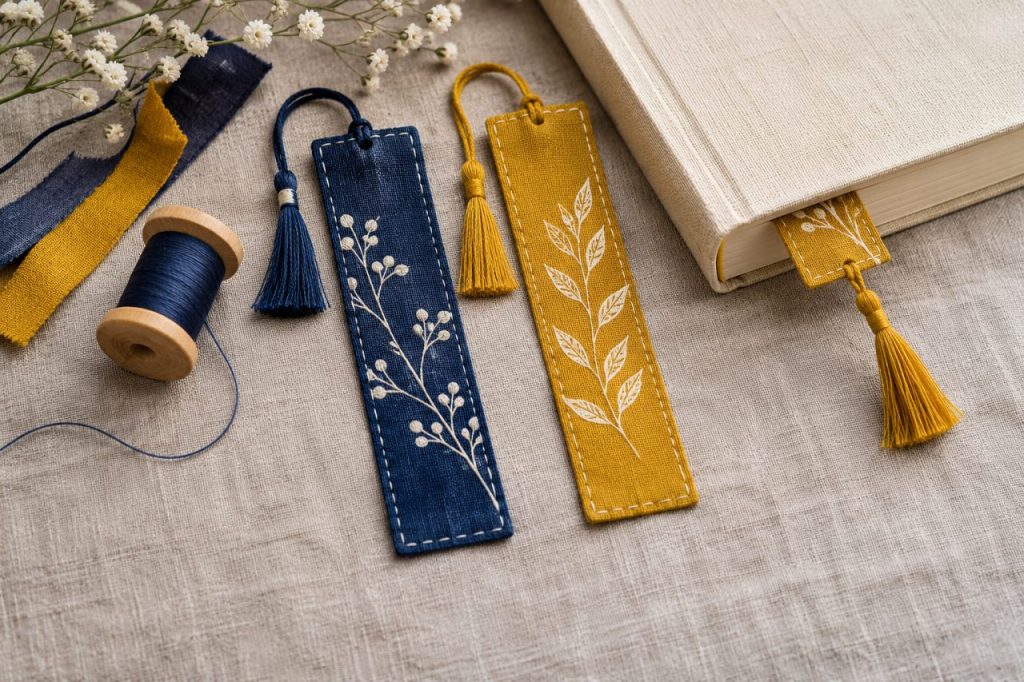
A flat fabric bookmark is a manageable project for offcuts too narrow for a bag or cushion. It practises cutting, turning and topstitching without needing a large amount of fabric. Keep the design thin: bulky decorations can mark pages or prevent a book closing properly. This version uses no beads, buttons, magnets or dangling cords.
Choose compatible scraps
Pick two stable woven pieces that can be washed in the same way. Avoid fabrics that shed heavily, transfer colour or have a sticky coating. Wash and press them as appropriate before cutting. If the fabric is very thin, a lightweight interfacing may help, but follow its manufacturer’s heat and application instructions. Test it on an offcut before applying it to the project.
Cut a simple rectangle
For a first version, cut two rectangles 7 cm wide and 22 cm long. With 1 cm seams, the finished bookmark will be about 5 by 20 cm. Place the pieces right sides together and mark a turning gap of around 5 cm along one long edge. A larger opening is easier to turn than a tiny gap in stiff fabric.
Sew and turn carefully
Stitch around the rectangle with the planned seam allowance, leaving the marked gap open. Secure the stitching at the ends. Trim the corner seam allowances to reduce bulk, keeping well clear of the stitching. Turn the bookmark through the opening and ease out the corners with a blunt tool. Do not push with scissors or a needle point, which can pierce the fabric.
Press and close
Turn the gap’s raw edges inward so they align with the sewn seam. Press according to the fabric’s care requirements. Topstitch around the entire bookmark, close enough to the edge to close the turning gap securely. Keep the layers flat and avoid pulling them through the machine. Hand stitching is also possible if the stitches hold both folded edges firmly.
Check it in a book
Place the bookmark between a few pages and close the book gently. It should lie flat without a hard ridge. If the edges curl, check whether the layers were stretched or cut off grain; pressing may help, but badly distorted layers are best remade. If ink or dye transfers to a clean damp white cloth, do not use that fabric in a valued book. Keep the first version as a size sample and adjust the next one to suit your usual reading.
Further reading
Reader discussion: small projects that use fabric scraps