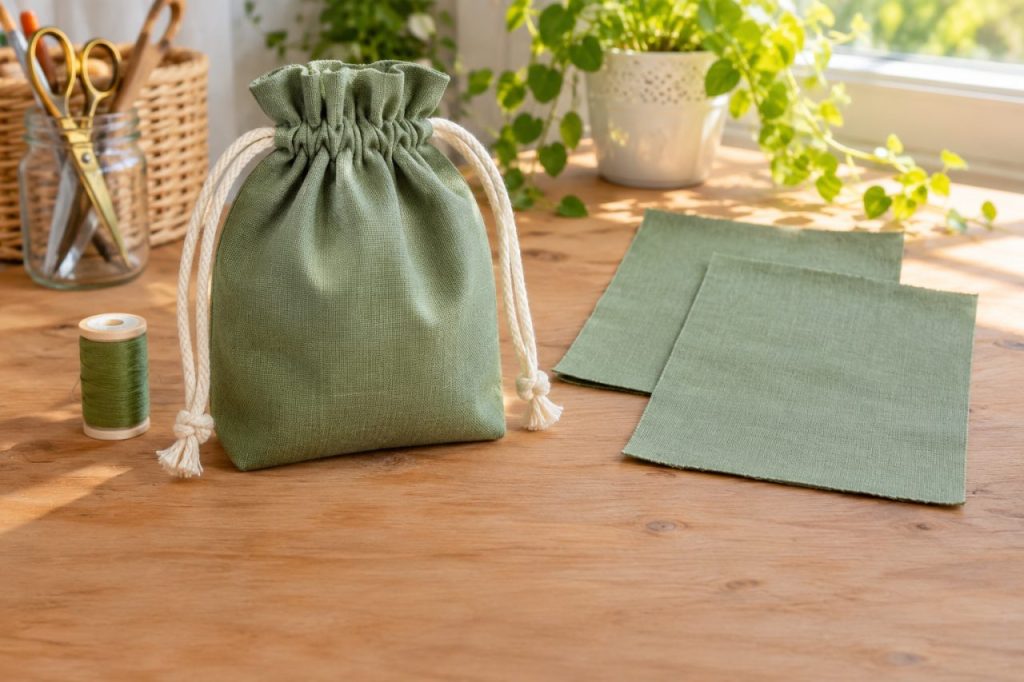
A drawstring bag is useful for adult craft supplies, spare cables or small travel items. Making one from two rectangles keeps the construction easy to understand. Choose a stable woven fabric and cord that slides freely through a sewn channel. This design is not a toy, a baby accessory or a food-storage bag; loose cords need to be kept away from young children.
Plan a practice size
For a small practice bag, cut two pieces 24 cm wide and 30 cm tall. Use a 1 cm seam allowance and reserve the top 5 cm of each side for the casing opening. The finished usable size will be roughly 22 cm wide and 25 cm tall, with some of that height occupied by the closure. Use an offcut first if the intended contents need a precise fit.
Join the body
Place the pieces right sides together and mark 5 cm down from each top corner. Sew from one mark down the side, across the bottom and up to the opposite mark. Secure the stitching at both ends. Finish the raw seam edges appropriately for the fabric. Press the side seam allowances open, including the unsewn upper sections, without stretching the fabric.
Prepare the casing openings
At each unsewn side edge, turn the raw edge inward and stitch it neatly so the cord will not rub against loose threads. Then turn the top raw edge of each panel down 1 cm and fold it down again by 3 cm to create a channel. Check that the channels align and remain open at the sides. Stitch close to each lower folded edge, keeping the opposite side of the bag out of the seam.
Thread the cord
Turn the bag right side out. Use a suitable threading tool to pass one cord through the front and back channels, returning to the starting side. Repeat with a second cord from the other side if you want a two-sided pull closure. Tie each cord’s ends together securely and trim unnecessary length. Remove all pins and threading tools before using the bag.
Troubleshoot before making more
If the closure sticks, check for a twisted cord, an accidentally stitched-shut opening or a channel too narrow for the cord. If the bag’s top frays, revisit the turned casing openings rather than covering the problem with a knot. Test the bag with its intended contents and keep the load modest. Record your cutting size and changes on paper; adjusting one dimension at a time makes the next version much easier to improve.
Further reading
Beginner sewing discussion: drawstring bags as a first project