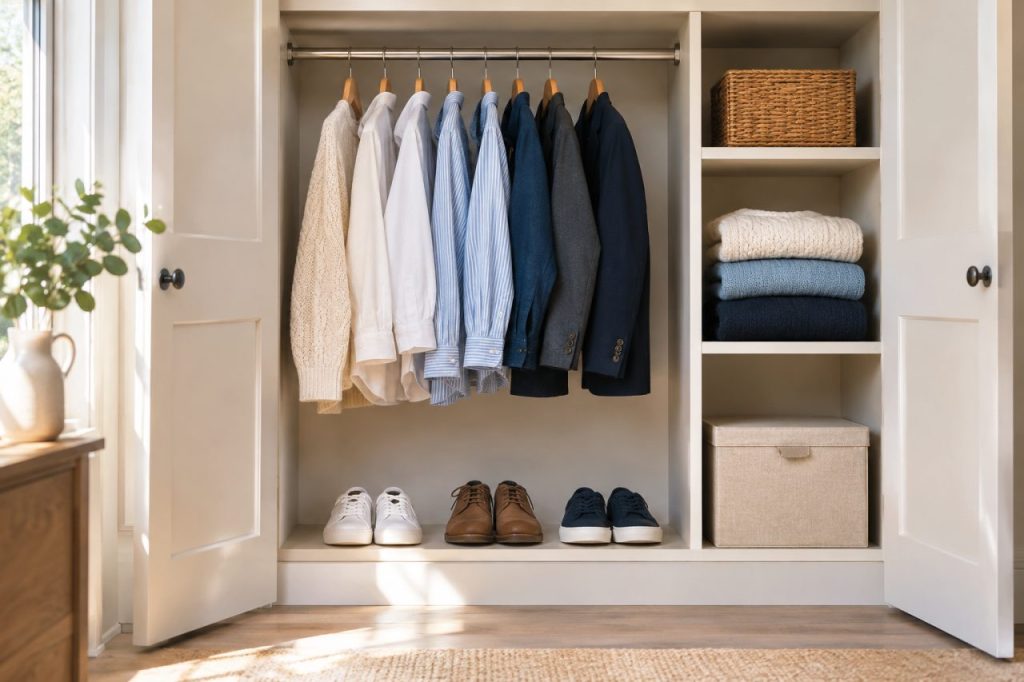
A small wardrobe does not need to hold every category of clothing in the same way. Hanging, folding and occasional storage each solve a different problem. Start with your normal week: the clothes you reach for most should be visible and easy to put away. This project rearranges existing storage before adding fittings or buying containers.
Empty one section at a time
Choose a section small enough to finish in one session. Sort it into everyday wear, occasional wear, repair or cleaning, and items you no longer want. Keep decisions separate from the clothes going back into the wardrobe. If you are unsure about an item, place it in a clearly dated review bag outside the everyday section rather than letting it block access.
Match storage to the garment
Follow garment care information when deciding what to hang or fold. Group clothes by use, such as work tops or exercise clothes, so the arrangement follows your routine. Use hangers that fit without forcing the doors closed. Keep heavy or bulky items low enough to retrieve comfortably. Do not overload rails, shelves or door-mounted accessories beyond their stated capacity.
Measure before adding organisers
Measure the internal shelf, the door opening and any hinge intrusion. A basket needs enough clearance to slide out without scraping adjacent clothes. Trial a category in an existing box before buying a matching set. Hanging organisers take up rail space as well as vertical space, so compare what they displace with what they hold. More compartments are not automatically more useful.
Create a return route
Leave a small amount of space in each group so clean laundry can be returned easily. Give worn-but-not-ready-for-washing clothing one defined location instead of scattering it across the bed and chair. Keep a repair bag separate from wearable clothes. If multiple people share the wardrobe, agree on zones that are visible without opening every container.
Review the bottleneck
After a week, look for the category that spills out or never gets put away. It may need more space, fewer items or a simpler container. For example, a deep box of small accessories may work better as two shallow groups. Avoid using the top of the wardrobe as an unstable overflow pile. A successful arrangement is one you can restore after laundry day, not just one that looks tidy immediately after sorting.