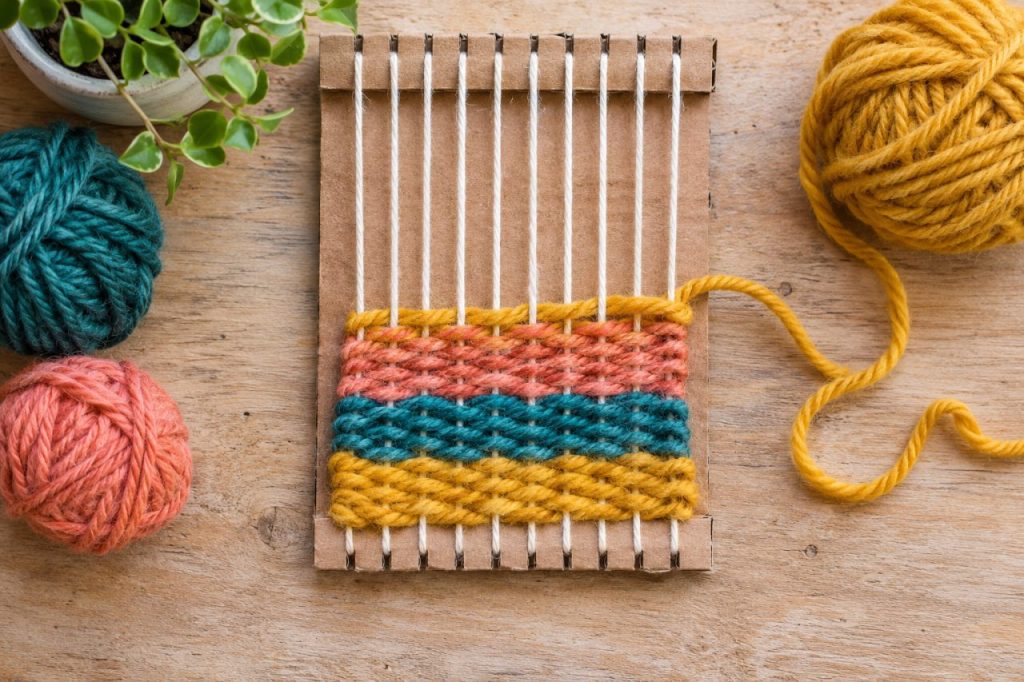
A cardboard loom holds threads in place while a child practises weaving over and under them. Start with a small piece and contrasting colours so the pattern stays visible. An adult should prepare the cardboard and supervise the yarn and tools. This activity is not suitable for unsupervised young children, and loose yarn should be kept short and away from babies and toddlers.
Prepare a firm loom
Use a clean rectangle of sturdy card, approximately the size of a postcard. An adult can cut evenly spaced shallow notches along two opposite short edges. The notches should line up and leave the cardboard strong enough to stay flat. Smooth or cover any rough edges appropriately. A very large or thin loom can bend before the weaving has properly begun.
Add the lengthwise threads
Secure the end of a suitable yarn on the back and wrap it through the opposite notches to create parallel threads on the front. These are the warp. Keep them straight but not so tight that the cardboard bows. Secure the final end on the back. Check the loom lies flat before giving it to the child.
Weave a short strand
Use a manageable length of contrasting yarn for the weft, the thread travelling across. A large blunt weaving needle suitable for the child can help, or the yarn can be guided by hand. Pass over one warp thread and under the next. On the return row, reverse the pattern. Leave a small loose curve before gently easing the row into place so the edges are not pulled inward.
Notice tension and pattern
If the work narrows, loosen the most recent row rather than pulling harder. If a long float appears across several threads, trace that row and redo the missed crossing. Keep the rows close enough to see the fabric forming, but do not force them so tightly that the card distorts. Stop while the child is still enjoying the process; the whole loom does not have to be filled.
Choose a simple finish
For a first attempt, leave the small weaving on the card and turn it into a display piece, securing loose ends on the back. Removing it requires the warp ends to be secured so the work does not unravel; an adult can handle that step using an appropriate finishing method. Do not turn loose yarn loops into wearable necklaces or toys for younger children. Keep a photograph of the pattern to inspire the next session.
Further reading
Itaú Cultural: cardboard-loom activity, video description